
Sensitivity
This document is based on a question that is asked frequently in our community, and we think it’s time to guide you through this subject.
What is Sensitivity?
Basically, when most people think about sensitivity they see it as a peripheral or a mechanical aspect of games, but in reality this is completely wrong.
Sensitivity is just a tool that moves your camera from Pixel A to Pixel B, that’s it.
When it comes to aiming, it does interact with other aspects like Muscle Groups and ROM (Range of Motion), making sensitivity a little more complex than what it seems.
What is “ROM”?
ROM, or Range of Motion, is the limit of motion that you are able to make with your mouse.
It depends on two factors: sensitivity and the game environment.
Let’s take Valorant as an example:
In Valorant, the Range of Motion is defined by the environment where the duels happen. Most of the time, it isn’t a very large ROM. Valorant engagements are far more focused on wrist/finger movements, it doesn’t matter what sensitivity you use (this doesn’t mean you shouldn’t use your arm, just that wrist and fingers are more optimal for most duels). The game is mostly decided by long-range micro‑adjustments, rarely flicks or super close‑range duels where you would need more arm.
Translating this to aim trainers is the same as playing a micro‑adjustment clicking scenario where you don’t need to move your mouse wide; little movements are enough to go from Target A to Target B. So, depending on the Range of Motion, you will be using different muscle groups.
When applying ROM to our practice, we can force a specific muscle group to work by picking scenarios where the environment is designed for that muscle group.
Muscle Groups
As mentioned before, different ROMs and different sensitivities can change the muscle group you will be using while aiming. To simplify, we call them:
- Arm Group
- Finger Group
- Wrist Group.
These muscle groups are activated when you pivot to use them to get to the target or to keep tracking a target. In the ROM explanation, we understood that we can force a muscle group by forcing an environment that focuses on it, but that’s not the only way. Sensitivity changes can also force us to pivot a muscle group naturally. For example:
If we’re playing Overwatch, the game environment isn’t as restricted as Valorant. We have wide maps, close‑range chokes, flying targets, and targets that go behind you all the time. In this case, ROM is very variable and sensitivity will define what muscle groups you use. If you go high sensitivity, you’ll naturally use more wrist and fingers; if you go low sensitivity, you’ll naturally use more of your arm.
But why is this important?
Learning how to use different muscle groups is vital for aim. Even if your sensitivity and ROM force you to use your arm more than your wrist and fingers, learning to use them well will make your aim better. You’ll be able to make better micro‑adjustments, more precise small movements. The same applies to learning to use your arm even if your game requires mostly finger/wrist – you’ll be able to keep your aim smooth and precise with your arm.
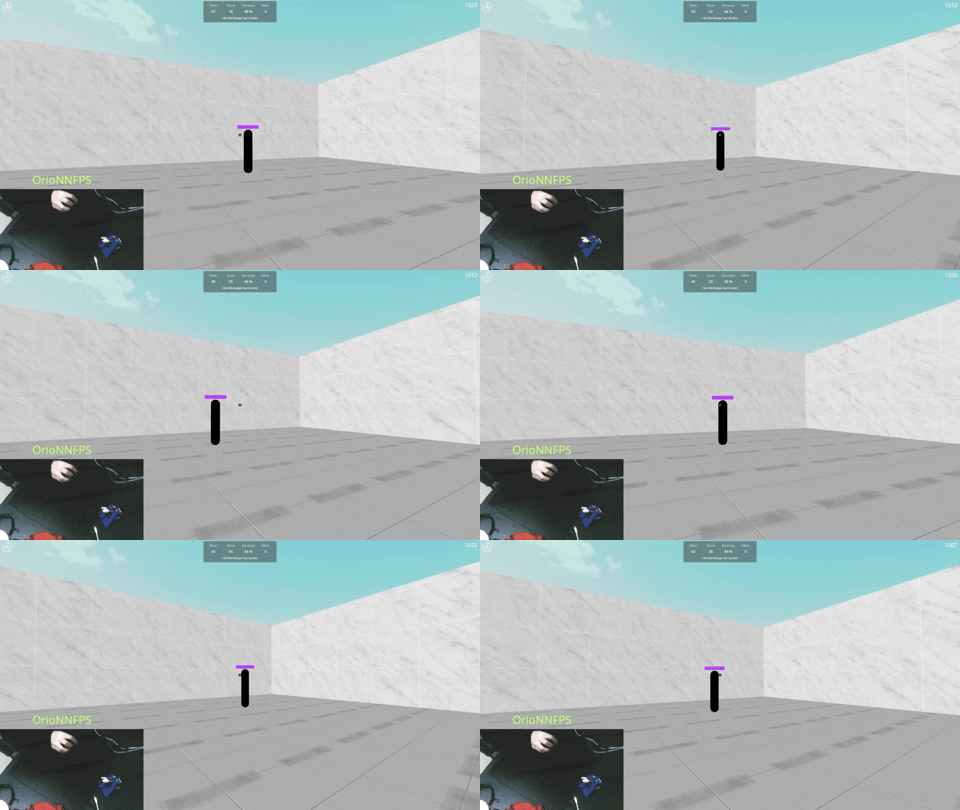
Muscle group driven by sensitivity | Arm 42CM

Muscle group driven by sensitivity | Wrist / Fingers 19CM
Conclusion
Remember: consistency is key. Prioritise improving your worst days over raising your peak, and always take care of your mental and physical health first.
MIRA r3d (hóngsè) | OrioNNFPS